
Canton Previous Residents by Era
Previous residents are best researched as a dated trail. Start with the present parcel and its legal description, then use the Recorder's period that matches the transfer. Add an address listing or census only for the date being tested. The table separates property evidence from household evidence, so an owner field is not mistaken for a list of people who lived at the address. Canton has several useful fallbacks when a web search stops, including the Recorder counter, the library research desk, map collections, and probate or archive custody information.
| Source | Years it covers | Where held | What it can show |
|---|---|---|---|
| Recorder current guide | 1982-present | Recorder and CountyFusion | Recorded transfers, liens, easements, and plats where relevant |
| Recorder archive guide | 1809-1981 | Recorder archive route or counter | Earlier grantor-grantee and instrument trail |
| Canton city directories | Discontinuous 1859-1930 | Stark Library Archive | Dated printed name, address, and calling snapshots |
| Haines Criss+Cross and phone books | Exact years not published | Stark Library research desk | Address-to-listed-person check |
| Federal census | Individual schedules through 1950 | National Archives and libraries | Household composition on the enumeration date |
| Sanborn maps | 1887, 1891, 1897, 1914, 1950 | Ohio Web Library or Library of Congress | Structure, use, street, and map context |
For a recent transfer, the parcel and current Recorder guide make the first pair. For a nineteenth-century question, begin with the archive guide, the legal description, surviving city directories, and the historic map date closest to the event.
Canton Previous Residents Start With Parcels
The Stark County GIS parcel service distinguishes the site address from owner, mailing, and billing components. It can also show PIN or PARID, legal description, sale date and price, previous owner, tax context, lot or allotment, and update date. A situs address is the physical parcel address. A mailing address is the place property mail is sent. Neither field establishes that every person connected to a name was present at the property.
Use the Stark County Real Estate Search for its public search routes, then use the verified GIS service if the property form is unavailable. During research, the Real Estate Search displayed Basic Search, Advanced Search, GIS/Map Search, and Septic & Well Search, but its field controls were under maintenance. Do not assume an unverified filter exists.
Record the parcel number, legal description, sale details, and exact address before opening a deed. That record set bridges a familiar street address to the Recorder's durable land description.
Canton Previous Residents Deed Trail
Stark County Recorder maintains recorded land documents and divides its published search guidance into two local periods: archive material for 1809-1981 and current material for 1982-present. A chain that crosses 1981 and 1982 needs both routes. CountyFusion provides a public-login path, and the county says public users can search records and view images. Online copies are described as free. If a result is incomplete, use the Recorder counter, public terminal, or a request for an image or copy by document reference. The original filed instrument controls over a web display.
- Open the current GIS parcel record and save the PIN, legal description, owner, sale date, and any transfer reference.
- Find the current purchase deed in the Recorder index using the party, date, and legal description.
- Read the image to identify the grantor and grantee, the parcel description, and the recording reference.
- Search the former party in the prior transfer role and compare the legal description, not only the street wording.
- Repeat through both Recorder guide periods, using the counter or copy route when the online index cannot resolve a link.
- Grantor
- The party giving or transferring an interest in a recorded instrument.
- Grantee
- The party receiving the interest in that instrument.
- Chain of title
- The sequence of recorded transfers tied to the same land interest.
- Legal description
- The lot, allotment, subdivision, or other recorded land description that is more stable than a street address.
A deed trail identifies a recorded ownership relationship. It is not a census of prior residents. Multi-parcel transfers, splits, combinations, trusts, and spelling variants need additional checking before a link is accepted.
Canton Recorder Index Periods
The two Recorder guides are a local boundary worth preserving in research notes. The archive guide covers 1809-1981, while the current guide begins in 1982. The division marks the county's search guidance, not a disappearance of older deeds. Recorder history identifies land-document records from 1809. When street labels change, a legal description, plat, PIN, and document reference are stronger links than an exact string match on an address.
The Recorder is at 110 Central Plaza S., Suite 170, Canton, and lists 330-451-7443. It describes online document copies as free, staff-made copies as $2 per page, self-service copies as $0.10 per page, and certification as $1 per document. A mail-copy request uses the fee and a self-addressed stamped envelope. Confirm counter opening time before visiting because the Recorder materials show different opening-time references.
Canton Previous Residents on Historic Maps
Historic maps help test the physical side of a prior-resident trail. Canton Sanborn sheets exist for 1887, 1891, 1897, 1914, and 1950 volumes. They can show a structure footprint, street name, fire-insurance notation, or land use for the map date. County GIS also identifies historic maps from the 1940s through 1997, pre-1940 660 maps, scanned surveys, and listed aerial imagery years. Such sources add chronology; they do not identify the people who lived at an address.
The Ohio Web Library Canton 1887 Sanborn viewer is the source shown below. Use the map edition closest to the recorded transfer or directory year, then preserve the edition date with the citation.
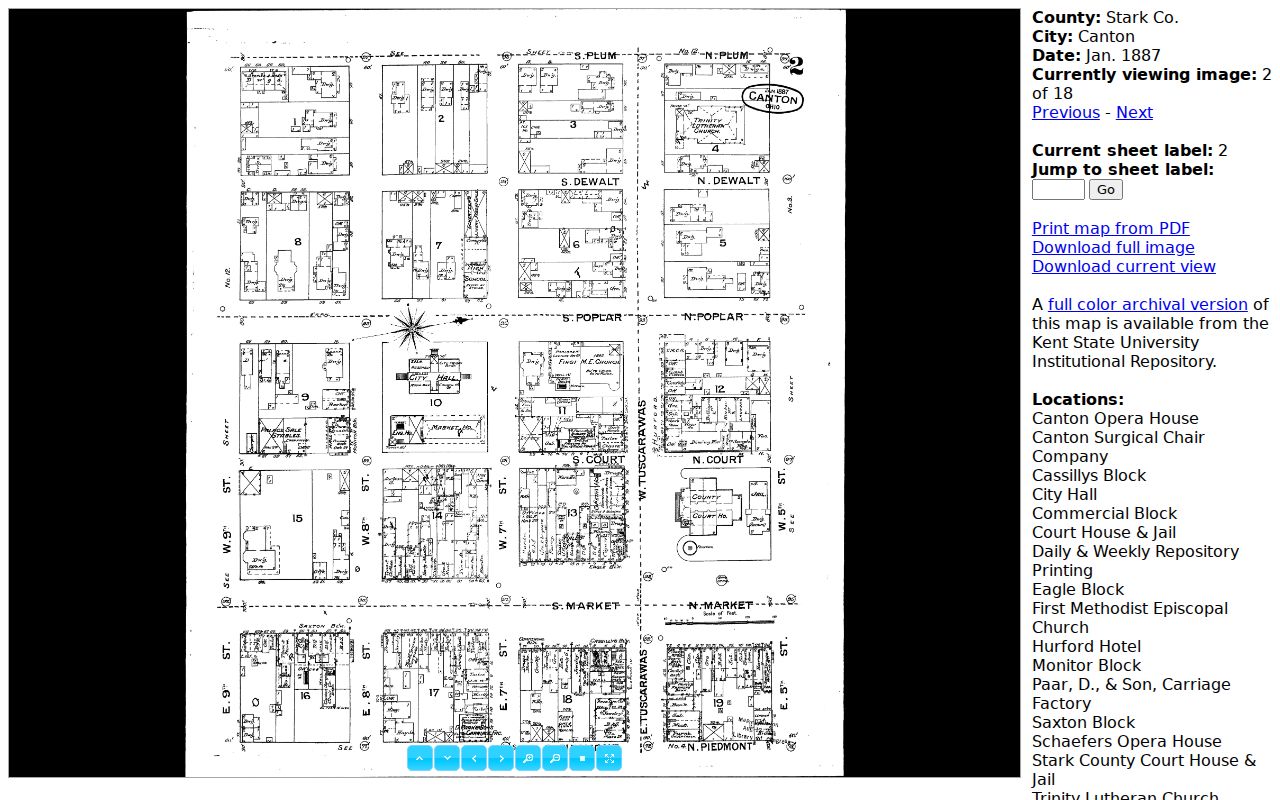
Where an old address does not line up, compare the official address point, historic tax map or lot index, recorded legal description, plat, and current boundary. No authoritative Canton street-renumbering date was located, so none should be assumed.
Canton Previous Residents Household Evidence
Who lived here before is a different question from who held title. Stark Library's digitized Canton directories are discontinuous from 1859 through 1930, and its Haines Criss+Cross Directory and phone books supply address-first research when staff can confirm the relevant run. Copy a directory entry exactly, then check the nearest earlier and later available issues. Pair that dated listing with the nearest open federal census. The 1850-1950 schedules can identify household members, while the earlier 1790-1840 schedules usually name only the household head.
- Choose the city directory nearest the target date and copy the address, spelling, spouse cue, and calling as printed.
- Ask Stark Library for a reverse-directory or phone-book check when the question begins with an address.
- Compare available years around the date, keeping missing editions separate from no-results.
- Locate the nearest open census and record its enumeration date and district before connecting the household.
- Use a newspaper notice, obituary, cemetery inquiry, will, or probate item only when its date and place support the same person.
For directory-year coverage and entry conventions, use the Canton City Directory collections. A printed residence line is a dated listing, not proof of a transfer, an entire household, or a current location.
Canton Previous Residents Trail Endpoints
Probate, newspapers, cemetery records, and index files can help close a documented historical sequence. Stark Library's index files include wills, naturalizations, tax and military-related indexes, grave-registration cards, notices, and obituary resources. The Probate Court historical-records list identifies whether older marriage, will, probate, birth, death, naturalization, or criminal-docket materials are retained at Probate, Stark Library, or University of Akron Archives. A 1988 transfer involved defined record groups and custodians, so the target record's listed holding matters.
The Stark County Probate historical-records page is represented by the source image below. It should be used to select the proper custodian, rather than assuming every old file remains at the courthouse.
Canton Cemetery Association has no verified broad public interment index. A focused inquiry is safer than inferring burial from a surname or a newspaper mention.
Canton Previous Residents Newspaper Dates
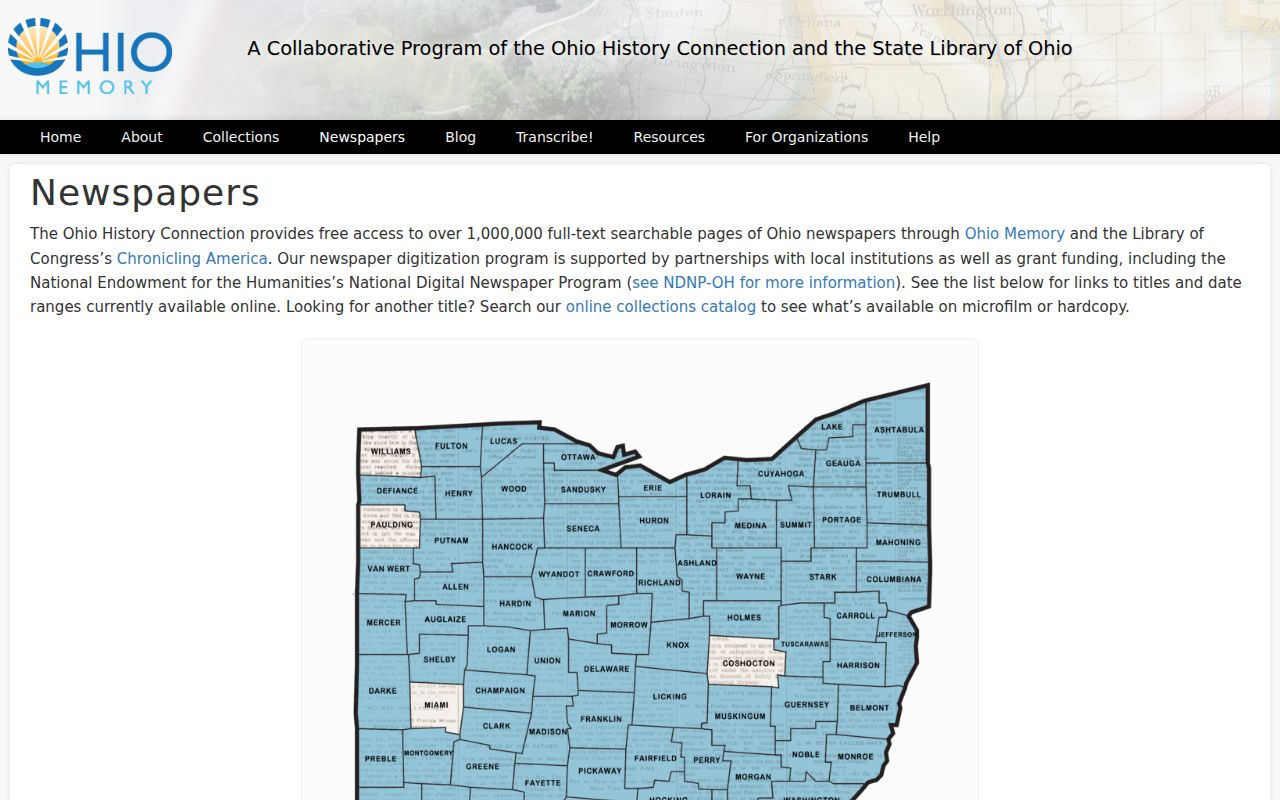
Newspapers are useful when a directory or probate lead supplies a narrow date. Stark Library's digitized runs include the Canton Daily News, Stark County Democrat, News Democrat, and Canton Morning News for their stated periods. Ohio Memory adds historic titles including Vaterlandsfreund, Ohio Staats-Bote, and Aviso. Try the name spelling carried by the dated directory, initials, a street address, and a date range. An OCR result should be checked against the displayed issue.
Ohio Memory's historic newspaper directory is the source shown below. Record the title, issue date, and page before connecting a notice to a prior household.
A notice can provide event context or an archival lead. It should not be extended into an unsupported story about everyone who may have been at an address.
Canton Previous Residents Use Limits
House history, family history, heir research, and local history are appropriate reasons to compare dated public sources. A living person's privacy still matters. Use only the record needed for the historical question, retain the source date, and do not use an address trail to watch, contact, harass, or harm anyone. Property fields, voter information, utility data, delivery records, and protected-address information have different access limits and cannot be combined into a complete household list.
Lawful use. Canton previous-resident research is for personal history and documented record questions. Stop when a result is protected, ambiguous, or unrelated to the address history being traced.
Ohio's Safe at Home program can protect a participant's address and confidential voter registration. The proper correction or redaction route is always the office that created or holds the particular record.